

After Unacknowledgment
Unacknowledgment is a powerful tool for narrative control and censorship. By withholding acknowledgment, people and institutions in power evade accountability while simultaneously denying legitimacy to their accusers.
Over time, a sustained policy of unacknowledgment can ostracize truth-tellers and regain control of public perception.
But what happens when the claims are too precise, the information too persuasive, the evidence too compelling, and the costs too high for the powers that be to maintain a policy of strategic unacknowledgment?
When witnesses and whistleblowers become impossible to ignore, the next tactic in the suppression playbook comes into play: character assassination.

What is Character Assassination?
Character assassination is the deliberate and sustained effort to destroy the reputation or credibility of an individual through attacks on their character.
The goal is to damage the target psychologically, reduce their public support, and degrade their ability to influence a debate, advance their cause, and successfully challenge those in power.
The path to successful character assassination runs through the undecided public, hesitant supporters, and eventually the core allies of the target.
Through successive attacks on a person's character and reputation, the perpetrator creates doubt, fosters outrage, implies guilt through association, and gradually reduces the target's ability to persuade others.
Eventually, the individual, and by extension their claims, can be politically and socially neutralized without the underlying evidence ever being refuted.
Pop Smoke!
This last point is key: character assassination changes the subject of debate.
The original claim can be anything - whether a government program exists, whether an official lied, whether evidence was concealed, or similar matters of public interest. The character attack diverts the conversation to an entirely different set of spurious questions:
What kind of person is making the accusation?
What are their politics?
What are their religious beliefs?
Who are they friends with?
Are they emotional, disgruntled, strange, or somehow beyond social norms?
The debate now shifts from “Is this information true?” to “Is this person socially acceptable?” Repeated often enough, a falsehood will drown out the evidence.
For those seeking the truth, these are not the same question. For those who never left the schoolyard, this is a shift to familiar, juvenile entertainment.
Credibility vs. Character
None of this is to say that the credibility of a witness is unimportant. Quite the opposite. A source’s placement, access, honesty, consistency, and proximity to evidence are all legitimate subjects of inquiry.
A provable lie about access matters.
Falsified or misrepresented career experience matters.
Fabricated documentation matters.
Duplicitous behavior matters.
What they says in private versus what they say in public matters.
But an individual’s political sympathies, religious beliefs, personal relationships, unpopular opinions, medical conditions, or casual mistakes do not magically make their claims or evidence disappear.
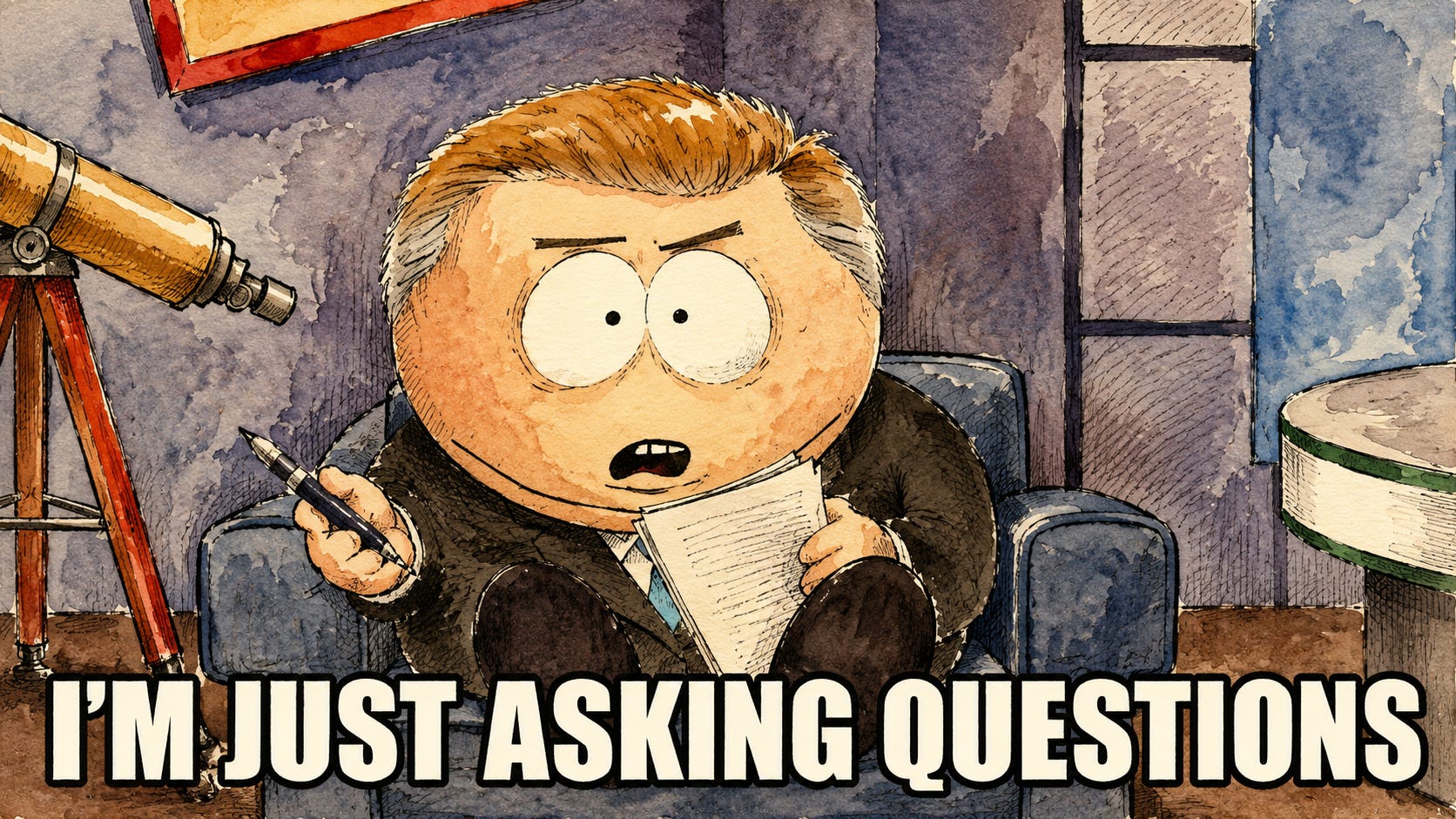
Character attacks exploit this distinction. By circulating false accusations, unsubstantiated rumor, ignorant speculation, innuendo, selective facts, and “just asking question” - bad actors redirect attention away from the claims and onto the person making them.
Instead of disproving the target’s analysis or evidence, the perpetrator makes the victim the controversy.
Thinning the Herd
When successful, character assassination ostracizes an individual from their political, cultural, and social environment. Relationships with allies, supporters, friends, and family can be destroyed beyond repair.
The victim of character assassination, if the attack is successful, is thus neutralized as an effective public voice.
Salacious rumors, “spicy” accusations, and personal drama are often far easier to consume than the difficult work of examining evidence, reconciling conflicting facts, and thoughtfully debating complicated issues.
In an age of constant consumption and addiction to outrage, low-quality content travels further than truth.
The perpetrator of a character attack cleverly avoids disproving evidence or critiquing analysis. Instead, they convince the public that a person is unworthy of consideration, unpopular to associate with, or ridiculous.
Herd mentality does the rest.

Catastrophic Calumny
Sophisticated actors, such as government gatekeepers, rarely attack directly. Instead, they find proxies whose jealousy, resentment, ambition, rivalry, or ideological hostility predispose them to uncritically spread disinformation. These intermediaries, often several steps removed from the sponsor of a character assassination campaign, carry out the actual attacks.
Once a rumor or “question” is repeated often enough, it becomes self-perpetuating within a community of interest - especially if its members are desperate for information regardless of quality or provenance.
Eventually people will repeat a titillating allegation so often that it becomes unquestioned “truth”, thus becoming part of the background knowledge considered relevant by the public.
At this stage, the attack is complete: a lie or half-truth has become accepted and self-sustaining within the targeted community. The victims of character assassination seldom have the time or resources to defeat and outlast character attacks.
When instigated by institutional or high-net worth perpetrators - who have asymetric resource advantages - character assassination campaigns often achieve at least a partial success through sheer staying power.
With Friends Like These…
In the history of the UFO or UAP disclosure movement, character assassination campaigns have been frequent and effective at manipulating the public away from relevant information and into infighting and nihilistic skepticism.
An exhaustive study of these incidents is beyond the scope of this article, but key categories of the character attacks commonly deployed against truth-seeking activists, journalists, and whistleblowers are worth outlining:
Money and Fame: In one word, this can be summed up as the “grifter” slander. This character attack targets the motivations of a public figure by claiming that they are releasing information, rallying support, or calling for reform solely to make money. This is effective because it offers a simplistic explanation for otherwise complicated behavior.
As a consequence, every interview, book, documentary, speech, or fundraising effort is reframed as evidence of greed rather than the consequence of becoming a public figure. Unsophisticated speculation about motive is substituted for serious examination of the claims and evidence.
Guilt by Association: This attack attempts to make the victim answer for everyone they know, meet with, work with, or are otherwise plausibly (or implausibly) linked to. Rather than demonstrating that the victim has lied or acted improperly, the perpetrator transfers the perceived or real flaws of another person onto them.
This can be effective in controversial, high-stakes debates because almost anyone who participates will eventually encounter people with unusual views, questionable reputations, or opaque interests.
Credentials and Access: Here, the attacker seeks to minimize a public figure's past roles, responsibilities, rank, access, or proximity to relevant information. By omitting, mischaracterizing, and minimizing these factors, the attacker creates doubt about both the witness and their information. Small distinctions in job titles, organizational hierarchies, clearance status, or similar nuances can be exaggerated into claims that the person “wasn't really in a position to know.”
This tactic is especially useful against national-security whistleblowers because the general public is unfamiliar with how compartmented access, government contracting, interagency assignments, or classified programs actually work.
Mental Health: A longstanding tactic in the UFO area, an attack on a public figure's mental health seeks to redirect extraordinary testimony into a discussion about psychological health. Once a witness can be characterized as unstable, traumatized, emotional, or injured, the audience is encouraged to interpret everything the individual says through that lens.
A diagnosis of PTSD, anxiety, or depression does not, by itself, provide a scientific basis for concluding that a person is dishonest, hallucinating, or misremembering events. Pop psychology replaces the relevant evidence, and the public is persuaded to doubt a person without ever examining what they actually said.
Politics and Ideology: This attack vector seeks to weaponize a community's existing political, ideological, or religious prejudices against a public figure. By fabricating, exaggerating, misrepresenting, or wrong-footing the victim's assumed beliefs the perpetrator leverages preexisting biases that have nothing to do with the evidence under consideration.
Once the target is successfully categorized as belonging to the “wrong” tribe, members of the opposing group are self-motivated to dismiss their information before examining it.
There are more categories of character attacks than listed here, as well as the specific ways information warfare implements them. Curious parties are encouraged to read further at these resources: George Mason University Lab for Character Assassination and Reputation Protection, Active Measures: The Secret History of Disinformation and Political Warfare, and The Firehose of Falsehood Propaganda Model.
Prejudice Obscures Truth
None of this means whistleblowers, journalists, activists, or other public figures are above scrutiny. This is a reminder to stay focused on the relevant questions: Did they have access? Are they telling the truth about their background? Does their story remain consistent? Is there obtainable supporting evidence?
But due diligence is very different from digging through a person’s life to smear their character. A person can have politics you disagree with, unconventional religious beliefs, PTSD, depression, failed relationships, financial problems, or an abrasive personality and still be telling you the truth.
In fact, when it comes to whistleblowers, one useful rule of thumb is to pay close attention to who is suffering the most for speaking out. Retaliation does not prove that every claim is true, but serious personal and professional consequences reveal a great deal about whose interests have been threatened.
Character assassination works because prejudices are easy to exploit and lies travel faster than truth. Once a smear “sticks” to a person, it becomes very difficult to remove. The effort to defend oneself can even be twisted into an admission of guilt. The sad truth is that much of the modern audience is more interested in petty drama and gossip than in the pursuit of truth.
The institutional effects of public character assassination are also harmful to the struggle for truth and justice. Those still working inside the system are watching what happens to those who dare to speak out.
When private tragedies are publicly ridiculed, medical histories mocked, families dragged through the mud, friendships destroyed, and entire careers reduced to fifteen minutes of shame, most will choose silence.
Shoot enough messengers, and eventually they will stop showing up.
The counter is not blind trust, nor is it unquestioning faith. The public should instead stay focused on the relevant questions:
What did the witness actually claim?
Did they have the placement and access?
What evidence supports them, and what more can be obtained?
What contradicts them?
Has anyone actually disproven what they said?
When the conversation suddenly diverts from these relevant facts into speculation about a person’s religion, politics, marriage, mental health, friends, or personality, ask yourself a very simple question: What were we talking about before everyone started gossiping?
More often than not, that question will lead you back to what bad actors are trying to distract you from.
"What were we talking about before everyone started gossiping?"
"More often than not, that question will lead you back to what bad actors are trying to distract you from."
This game has been played against us for a long time. It's so old it's a long white beard.
But the cellphone and the Internet has changed everything. Bit by bit, piece by piece, the evidence grows. People who you never knew existed in the old days now come forward and speak irrespective of the Washington Post or the NY Times or ABC "news". People at the level of Grusch, or physicist Dr. Eric Davis, or whistleblowers like Borland and Matthew Brown and many others.
The sands of the hourglass of deception and distraction are running out and fear grips those desperate to continue to conceal the truth. The greatest fear of the Coverts.....EXPOSURE.
Great stuff as always Matt. Because you know my background I will offer this: When one can demonstrate true objective bias that is relevant to the topic in question, that is an effective, and valuable, way to challenge credibility. But, as you excellently point out, bringing in all this extraneous garbage that has little to nothing to do with the topic at hand is nothing but character evidence and assassination. Oh, and for the “record”, character evidence is generally inadmissible in civil court (it’s more complex in criminal cases) and excluded under the Federal Rules of Evidence. Keep fighting the good fight my friend 💯